

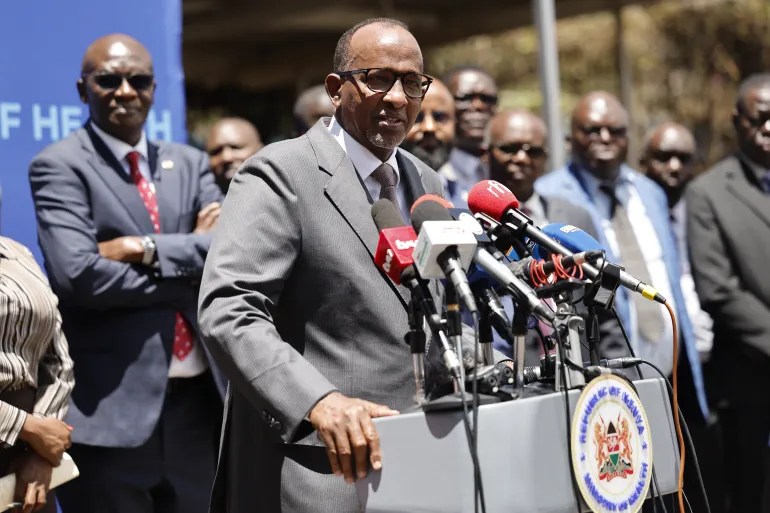
Kenya has recorded its first-ever case of Ebola, health officials confirmed this week, after a man who had spent 11 years living in the Democratic Republic of Congo died in Nairobi from the same Bundibugyo strain driving one of the deadliest Ebola outbreaks in Central Africa’s history.
The patient traveled by road from Beni, in eastern DRC, to Kampala, Uganda, on October 2, then boarded a Jambojet flight to Nairobi the following day. He passed through routine airport health screening on arrival before falling ill with fever, chills and subcutaneous bleeding — classic hemorrhagic fever symptoms. He tested positive for the Bundibugyo variant of Ebola and died shortly after, officials said; health workers carried out a safe burial to limit further exposure.
Kenyan health authorities are now monitoring 28 contacts and are trying to track down 23 fellow passengers and four crew members from the Jambojet flight. The country says it has screened more than 652,000 travelers at points of entry since mid-May and has tested 267 suspected samples, while training roughly 5,000 healthcare workers to recognize and respond to the virus.
“The priority now is to move swiftly to detect any further cases before the virus has an opportunity to spread,” said Dr. Mohamed Janabi, the World Health Organization’s regional director for Africa.
The case underscores how far the outbreak has traveled since it was first declared in DRC’s Ituri province in May. The epidemic has since grown to roughly 8,500 confirmed cases and more than 4,100 deaths — a case-fatality rate above 48%, among the highest recorded for any Ebola outbreak — spreading across 63 health zones in seven provinces. It has already crossed into Uganda and South Sudan border areas, and Kenya’s case marks a fourth country touched by the virus. No approved vaccine exists for the Bundibugyo strain, unlike the Zaire strain for which effective vaccines were deployed during West Africa’s 2014-2016 epidemic.
Ituri remains the epicenter, with more than 6,000 cases recorded since May, while North Kivu — wracked by years of armed conflict — now accounts for roughly a third of new infections nationally and a mortality rate near 60%, higher than the outbreak’s already-grim average.
Response efforts are badly strained. Dr. Jean Kaseya, who leads the Africa Centres for Disease Control and Prevention, said contact tracing has fallen far short of what is needed: “We have just 30,000 people in the contact list,” he said, against an estimated 420,000 people who should be under observation. WHO Director-General Tedros Adhanom Ghebreyesus has pointed to the same obstacle slowing the response across the region: “Conflict, displacement, and access problems significantly hamper response efforts.”
For Sierra Leoneans who lived through the 2014-2016 West African Ebola epidemic, the images emerging from Central Africa — overwhelmed treatment centers, contact-tracing teams racing against the clock, communities disrupted by burial restrictions — will carry a painful familiarity. Health officials across the region are now watching closely to see whether the virus can be contained before it reaches further beyond Central Africa’s borders.
Sources: Al Jazeera, CIDRAP (University of Minnesota Center for Infectious Disease Research and Policy)


Leave a comment