

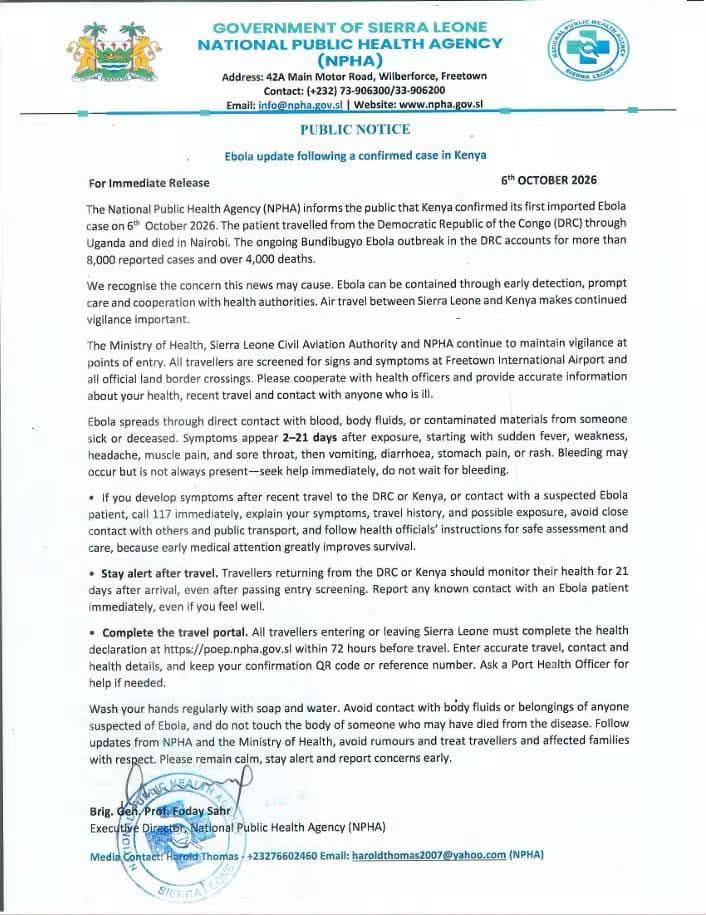
Sierra Leone’s health authorities moved this week to tighten screening at Lungi International Airport and the country’s land borders after Kenya confirmed its first imported case of Ebola, a reminder of how quickly the virus can travel along Africa’s busiest air routes.
Kenya’s Ministry of Health said on October 6 that a traveler who had passed through the Democratic Republic of Congo and Uganda before arriving in Nairobi later died there from Ebola caused by the Bundibugyo strain, the same virus behind an ongoing outbreak in DRC’s Ituri Province. The death, confirmed by Kenyan officials and reported by Al Jazeera and other outlets, marked the first time the current outbreak had reached East Africa through international travel, raising alarm across the continent about gaps in airport and border screening.
Sierra Leone’s National Public Health Agency (NPHA) responded within hours. In a communiqué issued the same day, the agency said flatly that “no suspected or confirmed Ebola case is currently recorded in Sierra Leone,” according to reporting by KOACI, while confirming it was watching the Kenyan situation closely given the dense air links connecting West and East Africa.
On the ground, the response has been practical rather than alarmist. The Sierra Leone Civil Aviation Authority (SLCAA) has intensified Ebola-prevention measures at Freetown’s main gateway, including routine temperature screening of all passengers and staff, mandatory hand-sanitisation points, prevention briefings for airport personnel, an airport clinic on standby for suspected cases, and an ambulance ready for rapid medical evacuation if needed. The authority said in a statement that the steps align with “national public health directives and international aviation health standards” and urged travelers and staff to “remain calm and cooperate with officials.”
Checks have also been stepped up at land border crossings, part of a broader national posture that public health officials say has been building since the DRC outbreak was first declared earlier this year. Sierra Leone’s health sector has run at an elevated preparedness level for months, with the Public Health Emergency Operations Centre keeping surveillance teams on standby in all 16 districts and rapid-response units positioned to isolate and transport any suspected case to designated treatment centers rather than treat patients at unprepared facilities.
Health officials are again leaning on a message the country has repeated since the 2014-2016 West African Ebola epidemic, which killed thousands in Sierra Leone: report symptoms early rather than wait. Residents returning from affected parts of Central and East Africa are being urged to monitor their health for 21 days and to call the toll-free line 117 immediately if they develop fever, severe headache, vomiting, diarrhea or unexplained bleeding. Authorities have specifically cautioned the public not to wait for visible hemorrhaging before seeking care, since that symptom does not always appear, and have asked citizens to avoid spreading unverified rumors about suspected cases.
For now, Sierra Leone remains free of Ebola and the World Health Organization continues to classify it as a low-risk country. But with Kenya’s case underscoring how one international flight can carry the virus across the continent, health officials here are signaling they would rather tighten checks now than scramble later — a lesson a country that lived through the last epidemic is not eager to relearn.
Sources: KOACI, Al Jazeera, Kenya Ministry of Health, Awoko Newspaper SL





Leave a Reply