

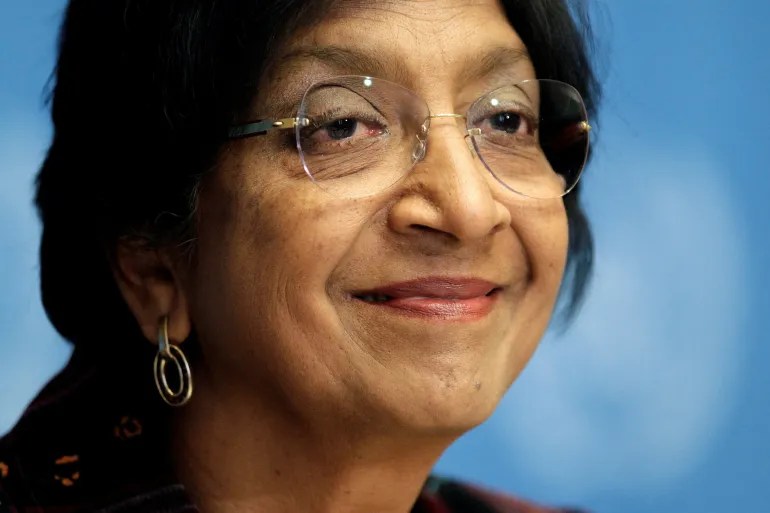
Navi Pillay, an 85-year-old South African judge who built a four-decade career confronting some of the world’s gravest crimes, was named winner of the 2026 Nobel Peace Prize on Friday, with the Norwegian Nobel Committee honoring what it called her “judicial rigour, personal integrity and considerable courage.”
Pillay, born in 1940 in Durban to a family of Tamil descent, became the first woman of colour to sit on South Africa’s High Court and the first woman to open her own law practice in Natal province. As a student and young lawyer, she joined boycotts and marches against apartheid and helped defend prominent anti-apartheid activists, including Phyllis Naidoo and Strini Moodley. In 1973 she won a case that secured legal access and basic rights for political prisoners held on Robben Island. “My human rights work has been shaped by what I experienced under apartheid,” she said in a 2016 interview cited by the committee’s biographical materials.
The Nobel committee pointed chiefly to her years on the International Criminal Tribunal for Rwanda, which prosecuted those responsible for the 1994 genocide. Under her leadership, the tribunal became the first international court to recognize rape and sexual violence as both crimes against humanity and acts of genocide, and it secured a landmark conviction of a defendant charged with incitement to genocide based solely on propaganda. The committee said the award matters now because international law “is under heavy pressure” and its institutions “are under attack.”
Pillay went on to serve as the United Nations’ High Commissioner for Human Rights from 2008 to 2014, and more recently chaired the UN’s Independent International Commission of Inquiry on the Occupied Palestinian Territory, which concluded last year that Israel bears responsibility for genocide in Gaza — a finding that drew sharp condemnation from Israel and some of its allies but was cited approvingly by the Nobel committee as an example of her willingness to apply the law without flinching. She currently sits as a judge on the International Court of Justice, which is weighing a separate genocide case against Myanmar over its treatment of the Rohingya minority.
Pillay said she first learned of the prize from media reports and had to ask whether it was true; organizers said they had struggled to reach her directly and appealed for anyone with a Norwegian phone number to answer their calls. Accepting the honor, she said she would dedicate it “to all of the survivors of international crimes,” adding that the award strengthens her conviction that people must “stand together to defend the rule of law and independent courts.”
Reaction poured in from across the human rights world. UN human rights chief Volker Türk called the award a reaffirmation that human rights, the rule of law and accountability “underpin peace, security and prosperity,” while International Criminal Court President Tomoko Akane said the choice carried particular weight amid mounting challenges to the global legal order — a reference to Washington’s sanctions last year against ICC officials after the court issued arrest warrants for Israeli Prime Minister Benjamin Netanyahu and former Defence Minister Yoav Gallant. South African President Cyril Ramaphosa praised Pillay’s “courage, integrity and commitment to justice.” Peace researcher Ashok Swain called her selection “the best possible choice,” suggesting it also carried an implicit message for US President Donald Trump, who has said publicly that he deserves the prize.
Pillay is the fifth South African to win the Nobel Peace Prize, following Albert Luthuli, Desmond Tutu, F.W. de Klerk and Nelson Mandela — a lineage that places her latest honor squarely within the continent’s long association with the award. For readers across Sierra Leone and the wider African diaspora, her career offers a reminder that African jurists have repeatedly stood at the center of the world’s most consequential reckonings with mass atrocity, from Rwanda’s genocide courts to today’s disputes over Gaza.
Sources: Al Jazeera, Amnesty International





Leave a Reply