

Sierra Leone’s government is pressing ahead with a plan to redraw local administrative boundaries and create new localities, with officials this week framing the overhaul as a response to population growth and uneven access to public services, even as they cautioned that any new council will be only as effective as the money and staff behind it.
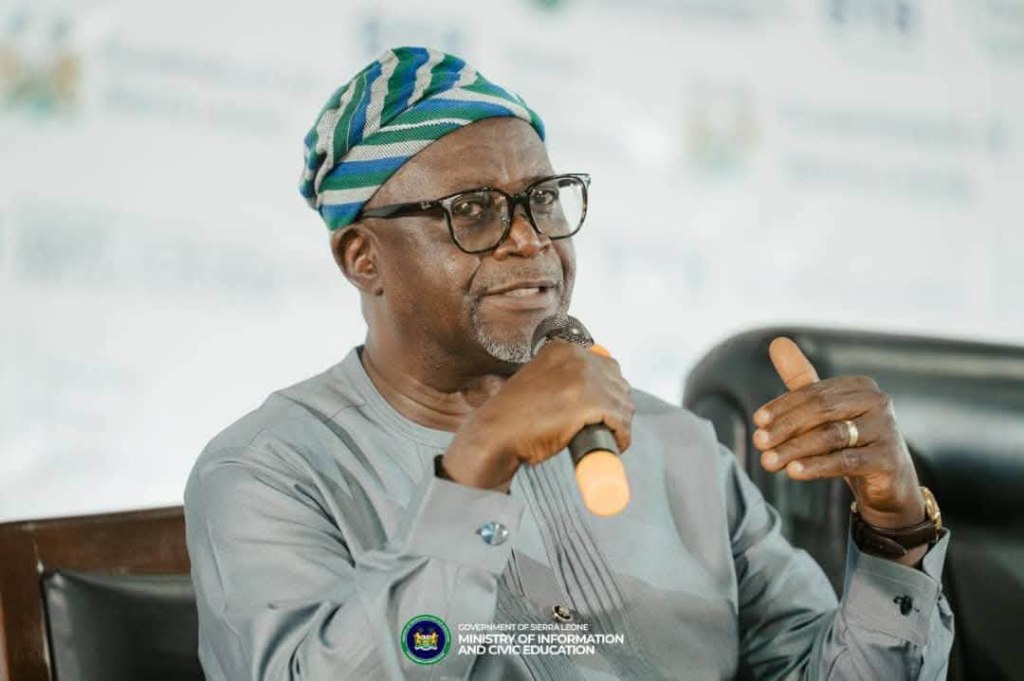
Minister of Local Government and Community Affairs Amb. Tamba Lamina laid out the rationale at the government’s Weekly Press Briefing on Tuesday, October 13, at the Miatta Conference Centre in Freetown, an event hosted by Strategic Communications Adviser Mohamed Jaward Nyallay. Lamina said the organisation of local administrative areas “must respond to changing population patterns,” geography and community needs, and argued that reviewing existing boundaries would let local authorities work more efficiently and respond faster to residents’ concerns.
The minister grounded the process in the Local Government Act of 2004 and its 2022 amendment, telling reporters that decisions on new localities require proper procedure: consultation with affected communities, coordination across government institutions, and sign-off from the ministries responsible for planning and finance. Factors under consideration include population size, geographic boundaries, administrative needs and a community’s existing capacity for self-governance. Officials argue the changes could shorten the distance residents travel to reach government services and help local authorities better identify development priorities, from infrastructure to markets.
That optimism came with a warning from Alex Bhonapha, Director of the Decentralisation Secretariat, who addressed the same briefing. Bhonapha said new councils would need “sustainable financing, stronger local revenue collection and development partnerships” to survive beyond their launch, and stressed that “redistricting involves more than changing geographical boundaries.” He noted that councils can raise some money independently through property rates and licensing fees, but that locally generated revenue alone cannot cover all of a council’s financial needs — meaning government grants and development-partner support, such as assistance the European Union has previously provided to local councils, will remain essential.
Both officials emphasised that new localities cannot simply be declared into existence. Bhonapha said administrative centres must be identified and infrastructure prepared before any new local government unit begins operating, while investment in staff training, financial management systems and administrative procedures is needed to avoid overwhelming thinly resourced institutions. The two officials called for closer coordination between the Ministry of Local Government and Community Affairs, the Decentralisation Secretariat, and other relevant bodies as the process moves forward.
Neither briefing disclosed how many new localities are under consideration, where they would be located, or a timeline for implementation. The discussion comes as Sierra Leone also prepares for its 2026 Population and Housing Census, data that is likely to feed directly into decisions on where new administrative boundaries are eventually drawn.
For now, the government’s message is one of caution dressed as ambition: redistricting is coming, officials say, but only as fast as the funding, staffing and planning behind it can keep up.
Sources: Ministry of Information and Civic Education (moice.gov.sl); Sierraloaded (sierraloaded.sl)





Leave a Reply