
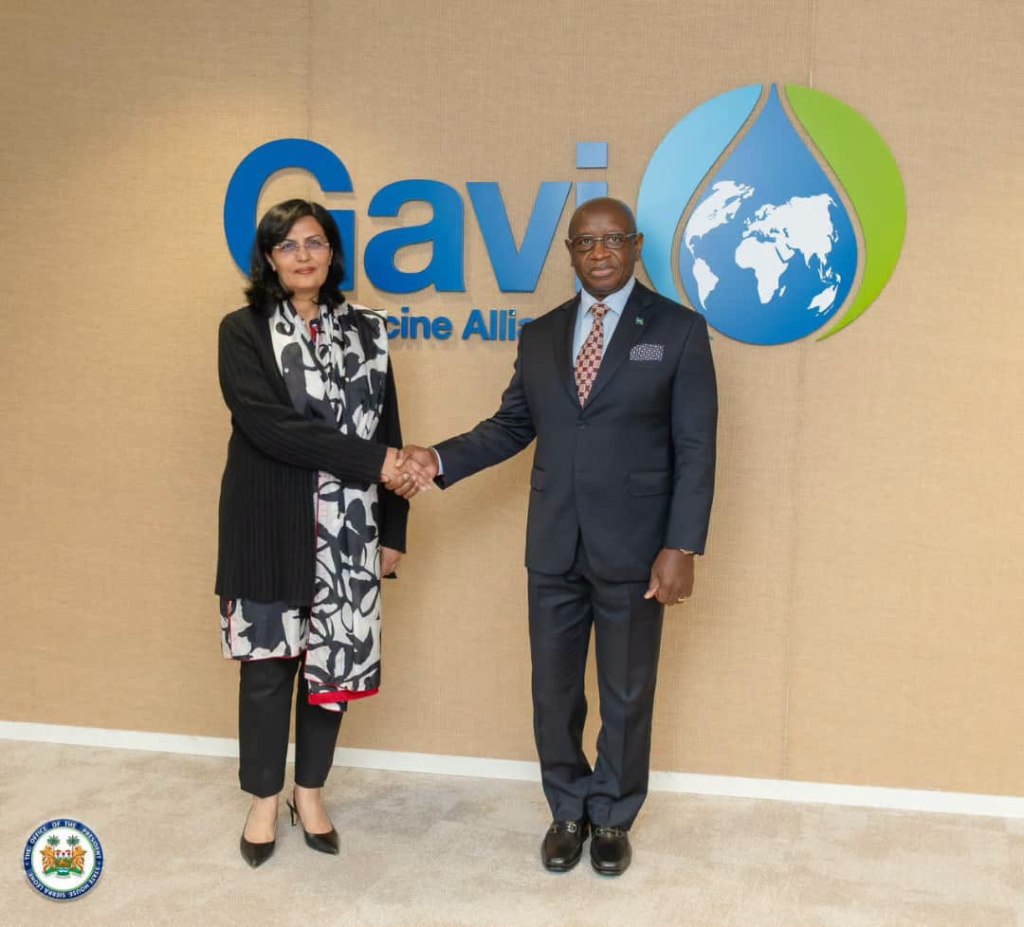
President Julius Maada Bio has welcomed a US$60.9 million allocation from Gavi, the Vaccine Alliance, that will fund Sierra Leone’s immunisation programmes through 2030, as the country looks to lock in gains made against childhood diseases even as donor budgets tighten worldwide.
Bio raised the allocation, issued under the alliance’s Gavi 6.0 funding cycle covering 2026 to 2030, during a high-level meeting with Gavi Chief Executive Officer Dr. Sania Nishtar at the organisation’s headquarters in Geneva, Switzerland, on October 14. “Sierra Leone greatly values its longstanding partnership with Gavi,” the President said, crediting the alliance with protecting “the health and lives of our people, particularly our children.”
According to figures cited by the government, Sierra Leone has pushed national coverage for key childhood vaccines above 90 percent, and 90 percent of public primary healthcare facilities now have working cold-chain equipment to keep vaccines viable from storage to delivery. Gavi support has also funded motorbikes and dedicated vaccine trucks to reach remote communities, and has backed the country’s response to the Mpox outbreak and its national Ebola preventive vaccination campaign.
Bio told Nishtar his government has exceeded its recent vaccine co-financing obligations and has committed roughly US$4.8 million in domestic funding for the 2026-2030 period, on top of financing more than 2,500 immunisation personnel nationwide. He pointed to the government’s 300 Days of Activism for Triple Zero initiative, which pushes district-level health authorities to be held accountable for preventing avoidable maternal and child deaths, as evidence of the country’s own commitment to the partnership.
The President used the meeting to press Gavi on two fronts: sustaining malaria vaccine coverage beyond 2027, when current funding commitments are due to lapse, and ensuring the newly announced Gavi 6.0 allocation is disbursed predictably and on schedule so that immunisation services are not disrupted through the end of the decade. Predictable financing has become a pointed concern for health ministries across the region as traditional donors, including the United States and several European governments, have scaled back global health aid over the past two years.
For her part, Dr. Nishtar thanked Bio for travelling to Gavi’s Geneva headquarters and commended Sierra Leone’s vaccination progress, according to the government’s account of the meeting. She also voiced Gavi’s backing for the 300 Days of Activism for Triple Zero campaign and encouraged the President to continue using his regional standing, including his current role as ECOWAS Chairman, to advance the alliance’s immunisation goals across West Africa.
The Gavi 6.0 allocation arrives as Sierra Leone’s health ministry works to extend vaccine coverage into the country’s hardest-to-reach districts, where cold-chain gaps and personnel shortages have historically slowed delivery. With the funding now secured, officials face the task of translating a multi-year pledge into steady, year-on-year disbursement that keeps clinics stocked and health workers paid through 2030.
Sources: AYV News, Agence de Presse Africaine (APA)

Leave a Reply