

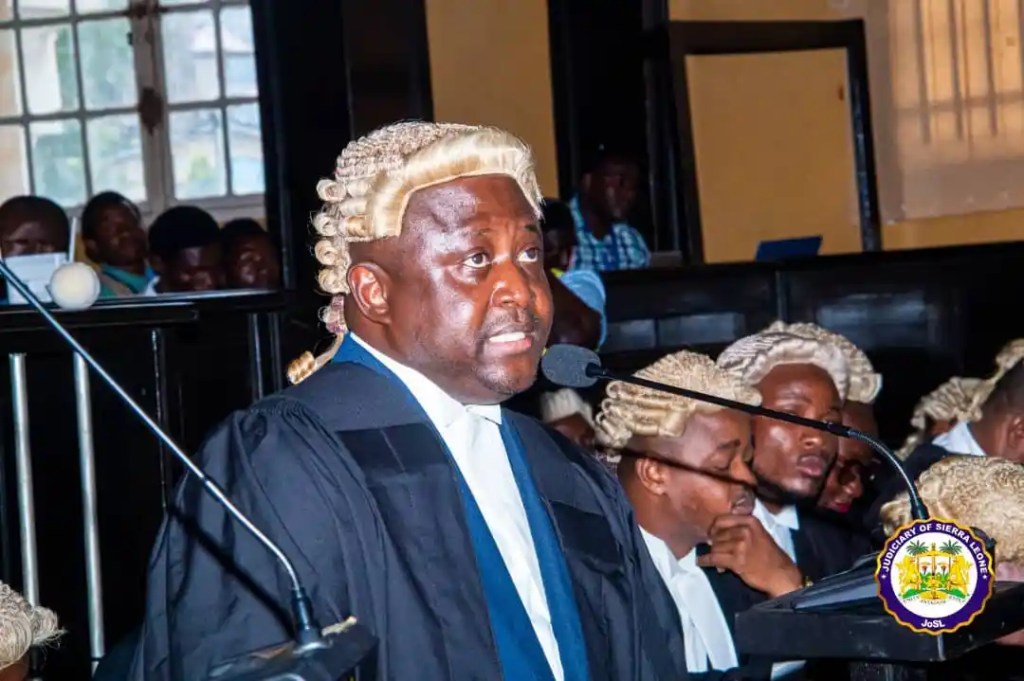
Sierra Leone’s Supreme Court has refused the government’s bid to throw out three consolidated lawsuits challenging how Parliament passed a constitutional amendment lowering the vote share a presidential candidate needs to win outright, clearing the way for a full hearing on a dispute that could shape the rules for the 2028 election.
Chief Justice Komba Kamanda ruled on Tuesday, October 20, that the Court has jurisdiction to hear the matter, rejecting arguments from the government’s Law Officers’ Department that judges could not review a bill Parliament had passed. No date has yet been set for the substantive hearing or a final ruling.
At issue is the Constitution of Sierra Leone (Amendment) Bill, 2025, which would cut the share of valid votes a presidential candidate needs to avoid a run-off from 55 percent to 50 percent plus one. Parliament approved the bill on August 10 after opposition All People’s Congress (APC) lawmakers walked out of the chamber, leaving it to pass by 96 votes. The APC, along with private citizens Thomas Moore Conteh and Tamba Kellie, argue that Section 108(2)(b) of the 1991 Constitution requires a two-thirds majority, or at least 100 votes of the 149-member Parliament, to amend the charter, and that the Speaker erred in ruling a simple majority of members present was enough.
The APC has called the process a “legislative heist, constitutional banditry, and legally void,” with the party’s National Secretary General Lansana Dumbuya declaring that “the Constitution belongs to the people” and that the party “will not stand by while our democracy is dismantled.” Lawyer Melron C. Nicol-Wilson, who separately petitioned the Speaker over the vote, argued that Parliament relied on the wrong constitutional provision and warned against treating “constitutional interpretation” as “a matter of parliamentary convenience.”
The government’s motion to dismiss, supported by an affidavit from senior state counsel Joseph Sesay, contended that the courts cannot inquire into a bill before the president has signed it and pointed to a constitutional provision shielding internal parliamentary proceedings from judicial review. The Supreme Court’s refusal to accept that argument means the case will now proceed to a full hearing on the merits of whether the vote itself was constitutional.
President Julius Maada Bio has not said whether he will sign the bill into law. He has instead referred it to the Supreme Court for an advisory opinion, a step that leaves the measure in limbo until the judiciary weighs in on both fronts — the reference and the separate challenge to how it was passed.
The dispute carries high stakes beyond the legal technicalities. Sierra Leone’s current 55-percent threshold has featured prominently in recent, closely contested elections, and lowering it to a simple majority plus one would make it considerably easier for an incumbent or front-runner to avoid a second round. Civil society groups and legal practitioners have pressed for judicial review, warning that a flawed process now could undermine confidence in the rules governing the 2028 vote regardless of which side ultimately wins at the ballot box.
With the Supreme Court’s jurisdiction now settled, attention turns to when the substantive arguments will be heard. Both sides are expected to file further submissions, and the outcome will determine whether the lower threshold stands, is sent back to Parliament for a fresh vote, or is struck down entirely ahead of the next general election.
Sources: Rio Times Online, Sierraeye Magazine, Premier Media Sierra Leone

Leave a Reply