

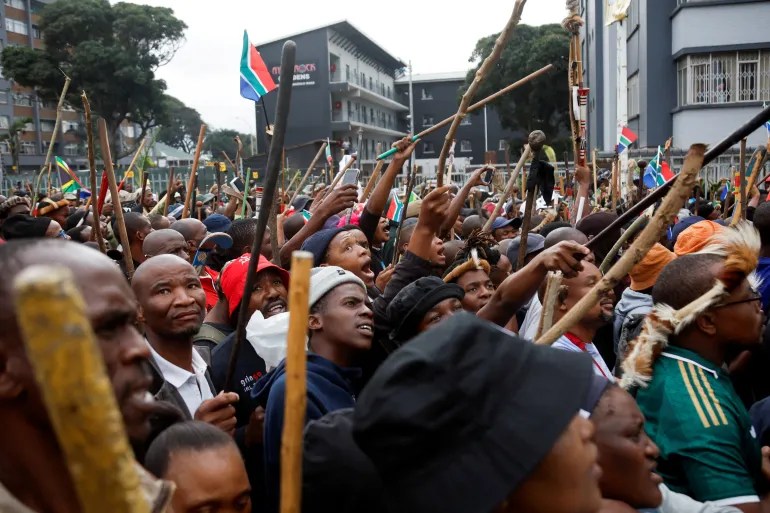
Thousands of refugees and asylum seekers across South Africa spent Wednesday bracing for possible violence as a deadline set by the anti-immigration movement March and March, demanding that undocumented foreign nationals leave the country by September 30, arrived with no legal force but considerable fear attached to it.
March and March, which has staged repeated demonstrations against immigrants and describes its campaign as targeting undocumented migration and crime rather than foreigners in general, first announced the deadline weeks ago. South African authorities have publicly rejected any suggestion that the date carries legal weight, warning that private citizens have no power to enforce deportations. Between June 14 and August 20, government officials say they processed 86,596 foreign nationals for deportation through official channels, a figure cited to underscore that removals remain the state’s responsibility, not a vigilante one.
For many refugees, the legal technicality has offered little comfort. Bishop Raphael Bahebwa, who has lived in South Africa for 26 years after fleeing the Democratic Republic of Congo, said he has gone into hiding. “I am in hiding now because they say they are going to kill me for speaking about the rights of foreigners,” he said, adding that he does not expect the pressure on migrant communities to ease once the deadline passes. “They are scapegoating us as foreigners. It is not going to end on September 30.”
Kafuti Muyumba, a Congolese refugee and community representative, described a climate in which law enforcement has done little to protect migrants from harassment. “Even the police allow March and March violence. They came with sticks and say we are attacking them,” he said. Muyumba, like many in his community, said returning home is not a realistic option given the DRC’s ongoing conflict in its eastern provinces: “There is still war there.”
The tension has already produced displacement. In mid-September, refugees were forcibly relocated from a makeshift camp outside a refugee reception center near Durban, where the choice on offer was stark: return to the communities they had originally fled, or accept transfer to Lindela, a government detention facility hundreds of kilometers away. Roughly 274 people were transported to Lindela, while about 150 remained in the Durban area searching for alternative housing. Earlier violence tied to the March and March campaign includes a September 3 confrontation in which members of the group attacked camp residents, injuring at least four people, and an earlier assault in which six refugee salon workers were beaten with sticks.
The standoff revives memories of South Africa’s worst xenophobic outbreaks, deadly riots in 2008 that killed dozens and displaced thousands, followed by further violence in 2015 and subsequent years. Rights advocates say the pattern of scapegoating migrants for unemployment and crime has resurfaced repeatedly despite government pledges to address it, and that Wednesday’s deadline, though legally meaningless, has already generated the kind of fear that can precede real harm.
As the deadline passed without official action, the coming days will likely determine whether March and March’s rhetoric translates into further confrontations, or whether government warnings against vigilante enforcement hold. For refugees like Bahebwa and Muyumba, the uncertainty itself has already reshaped daily life, from where they sleep to whether they feel safe speaking publicly about their situation at all.
Sources: Al Jazeera, MyJoyOnline.




Leave a comment